A donated cow skull, and a cautionary tale about teeth
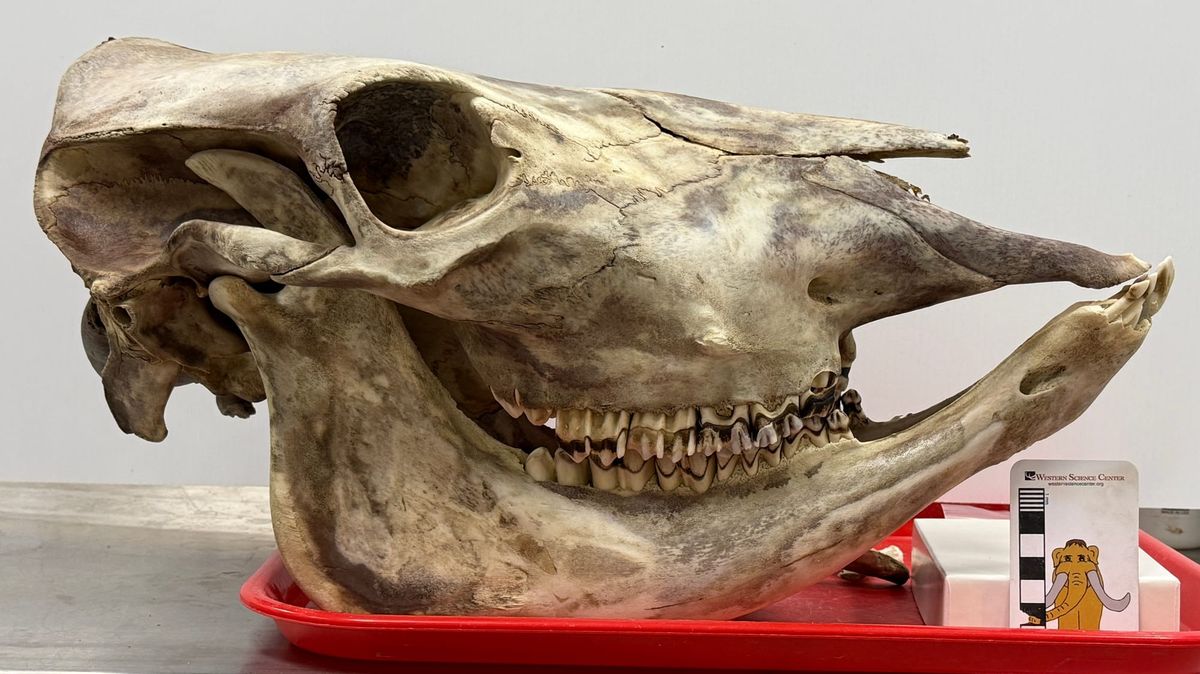
The Domenigoni family are long-time supporters of the Western Science Center. Among other things, each year at our Science Under the Stars fundraiser they donate the beef from half a cow to be auctioned off to raise funds for the museum. After the 2025 auction we asked if they could also donate the cow’s skull so that we could add it to the museum’s reference collection of modern animal skeletons. After we received the skull, most of the soft tissues were dissected out by student volunteers, then the bones went into our dermestid beetle colony for a final cleaning. Both the bones and the teeth will provide useful references for us; the upper teeth are shown below, including the deciduous premolars and the permanent molars.
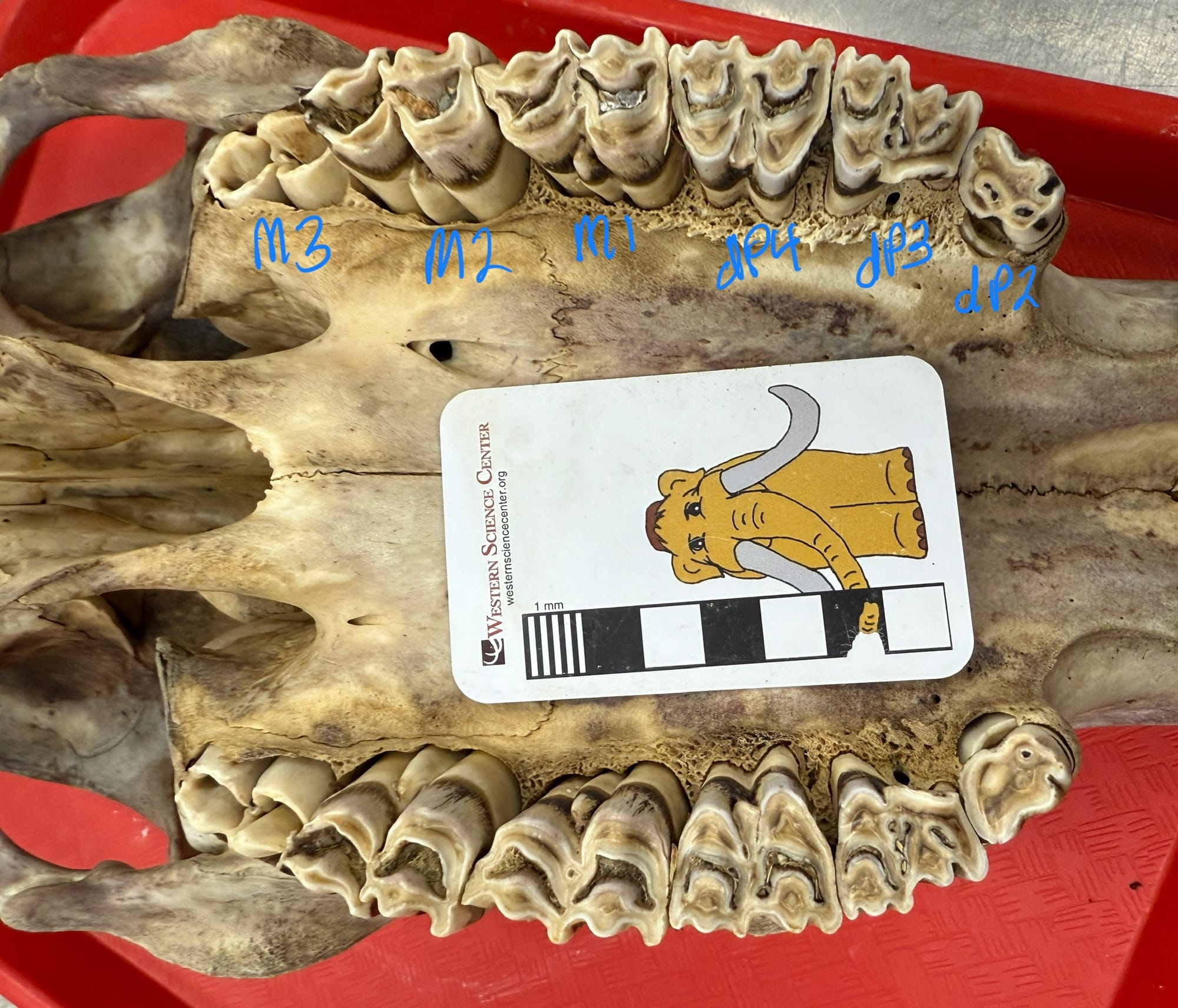
In Holocene deposits (less than about 10,000 years old), a frequent difficult identification concerns teeth from large bovids (members of the cow family). Bovids are not native to North America and different groups arrived at different times. Among the most recent arrivals are the largest members of the family: Bison arrived in the United States around 250,000 years ago, while Bos (domestic cattle) arrived with European colonists a few hundred years ago. How do we distinguish between these similarly-sized and closely related species if all we have are teeth?
The “rule of thumb” is to look for the presence of styles and stylids in the molars. Styles (in the upper teeth) and stylids (in the lower teeth) are small columns of enamel that sit between the main cusps of the teeth. On the occlusal surface these columns are expressed as a small loop or ring of enamel once the tooth is sufficiently warn. Supposedly these columns are nearly universal in bison, but are less common and less prominent in cattle.
Enter our new cow donation:
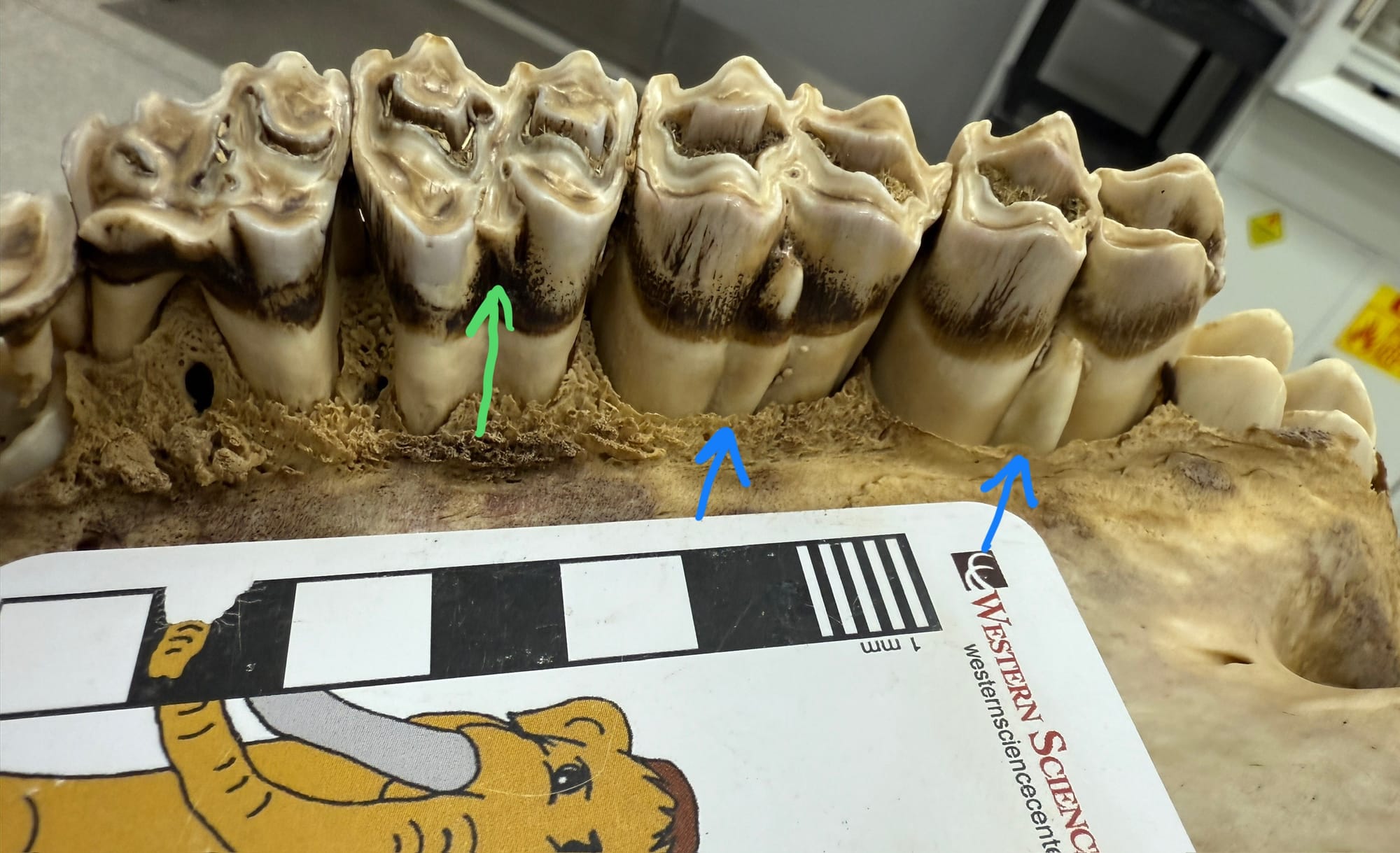
There are well-developed styles on both the 1st and 2nd molars (blue arrows) as well as on the 4th deciduous premolar (green arrow). The 3rd molar is unerupted, so it’s not clear if it also has a style. We see a similar pattern in the lower teeth:
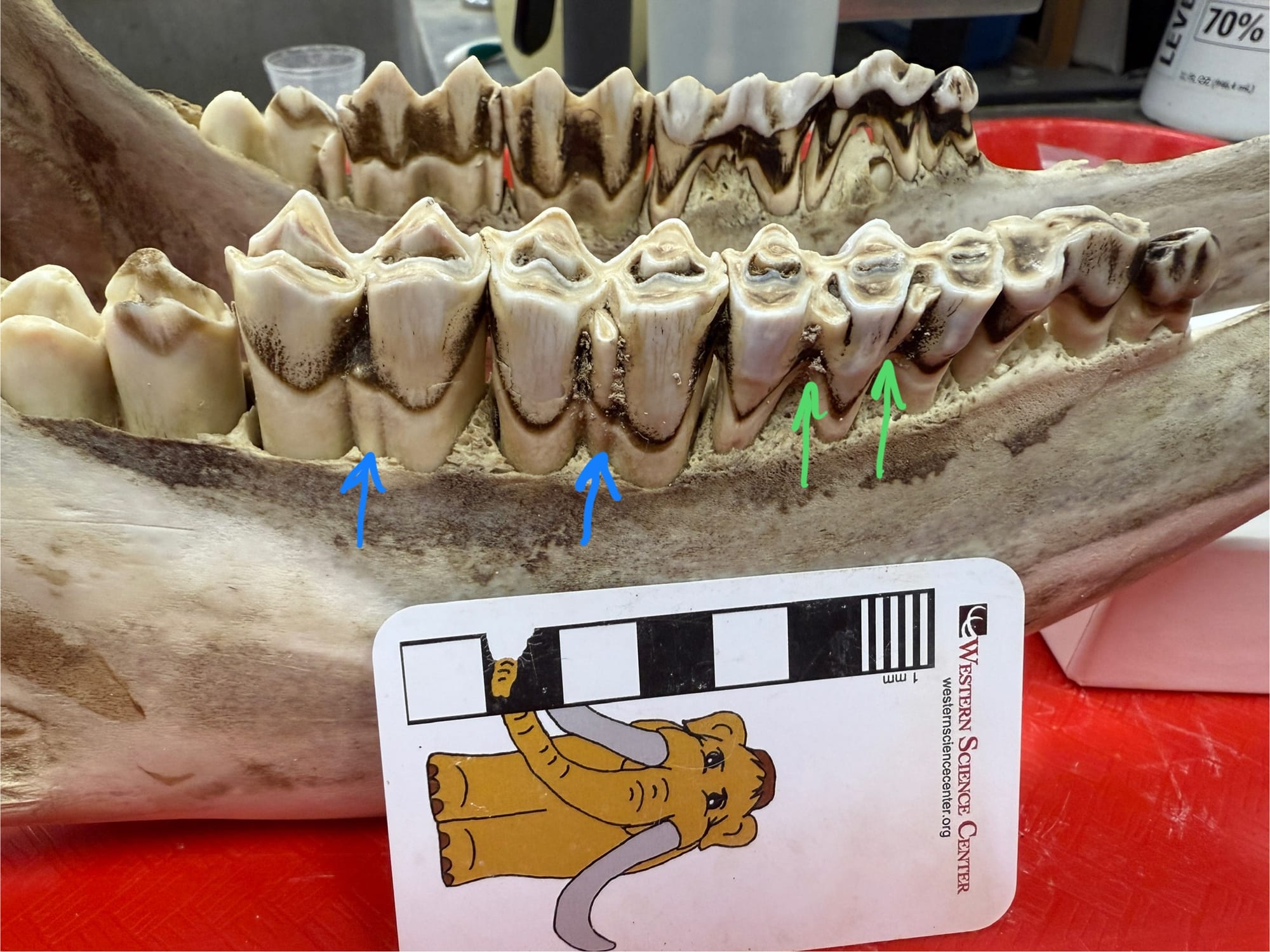
Here the stylid on the 1st molar is in wear, so the small enamel ring is visible. The deciduous 3rd premolar actually has two well-developed stylids. The stylid on the 2nd molar is a little weaker than I would expect on a bison, but in all other respects these teeth could easily pass for bison if I didn’t know that they come from a cow.
And that really is the lesson in dealing with small anatomical details, especially in closely-related species. Sometimes these identifications are tough, or even impossible. Part of paleontology is understanding what you know, what you think you know, and what you suspect to be true but is far from certain.
Thanks to the Domenigoni family of this very helpful donation.

If you like what you're reading, please consider becoming a paid subscriber or leaving a tip. All proceeds go to cover the cost of maintaining the site and supporting research and education at the Western Science Center.