A little jaw bone from Murrieta
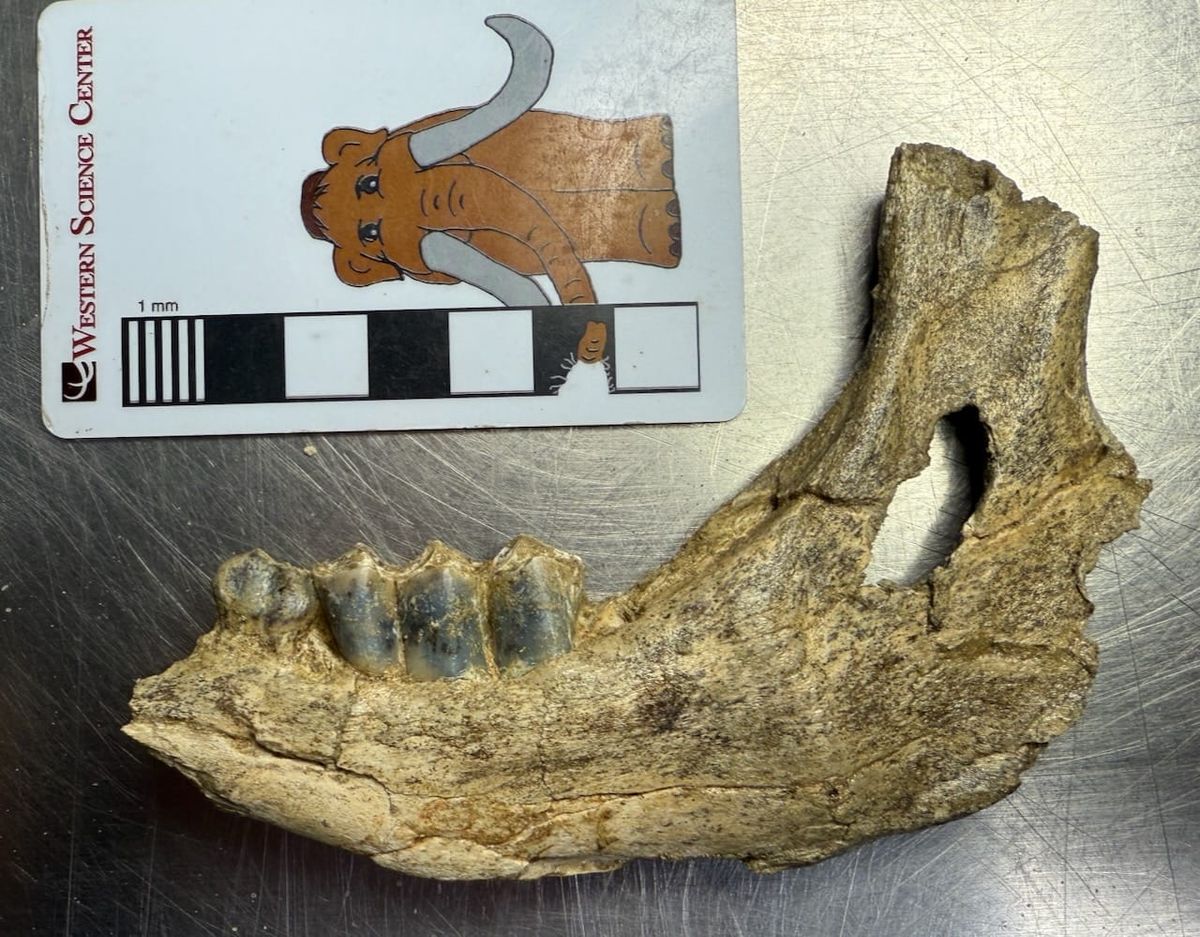
A few weeks ago Leya and Jessie, one of our volunteers, were going through boxes of poorly-documented material collected from Temecula Valley that eventually made their way to WSC, looking for potential specimens for our new exhibit. One of the specimens that turned up from a site in Murrieta were two fragments from a small lower jaw. We were looking through a lot of boxes, so I only had a few seconds to look at each specimen. For this one, I noted the small size and the three columns of enamel on the back tooth. That type of tooth is called selenodont, and the three columns are typical of the lower 3rd molar, the last tooth in the jaw (the other molars only have two columns of enamel). Selenodont teeth are found in artiodactyls such as bovids, cervids, and camelids, and based on all of this I decided the jaw was probably from a white-tailed deer (Odocoileus virginianus). I asked Leya to pull the jaw and do some cleanup for possible inclusion in the exhibit.
After some light prep work I looked at the jaw again, this time more closely, and started to have some doubts about my identification. First, even though the tooth had three columns of enamel the shape was unusual for a 3rd molar. In typical 3rd molars, the last column is much smaller than the other two, but in this tooth the 3rd column is the largest of the three, as you can see in the occlusal view below. Second, the small tooth in front of this one looks nothing at all like a 2nd molar.
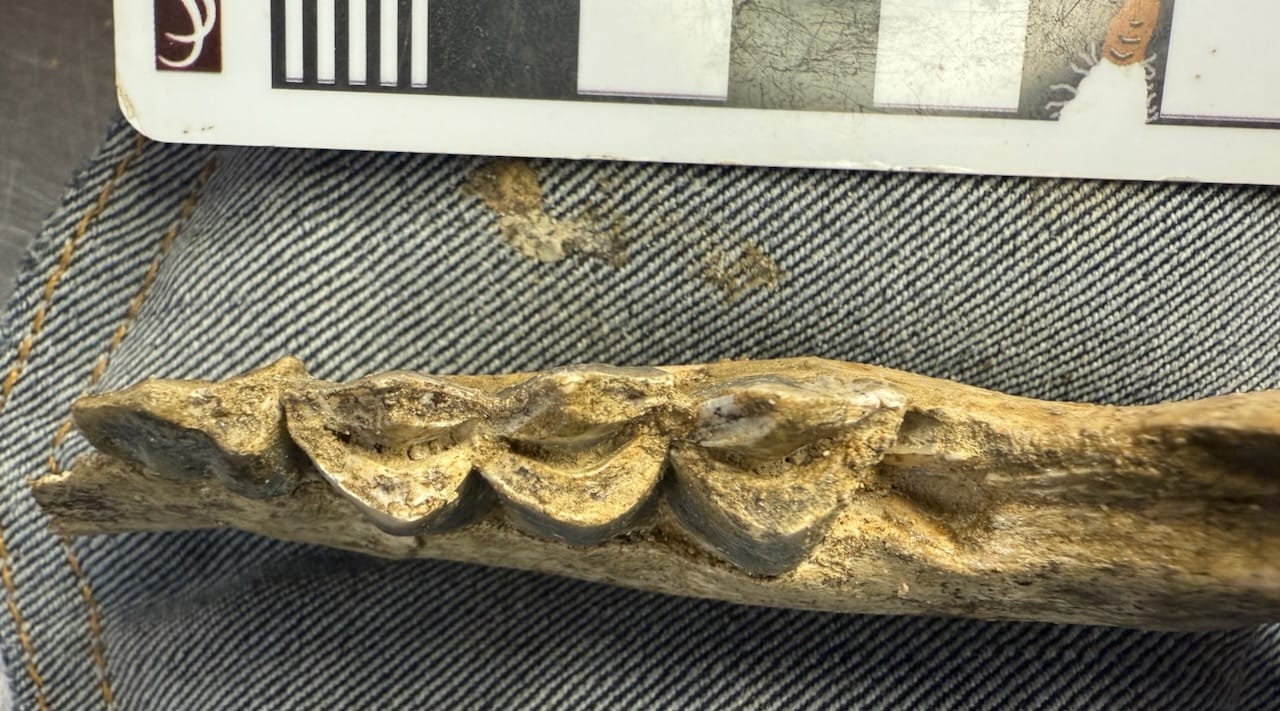
Looking at the other fragment presented even more issues. In front of the small tooth is a long toothless stretch called a diastema. A diastema is common in artiodactyls between the incisors and the cheek teeth, which means that this animal only had 2 cheek teeth in its lower jaw; most artiodactyls have 5 or 6.
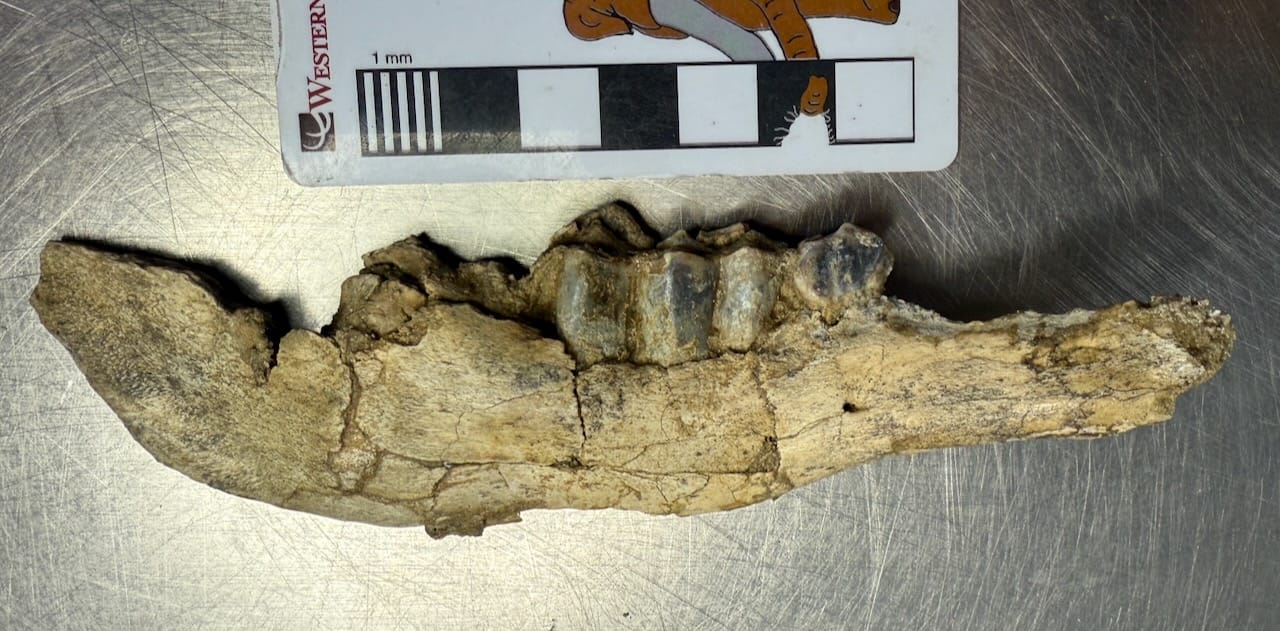
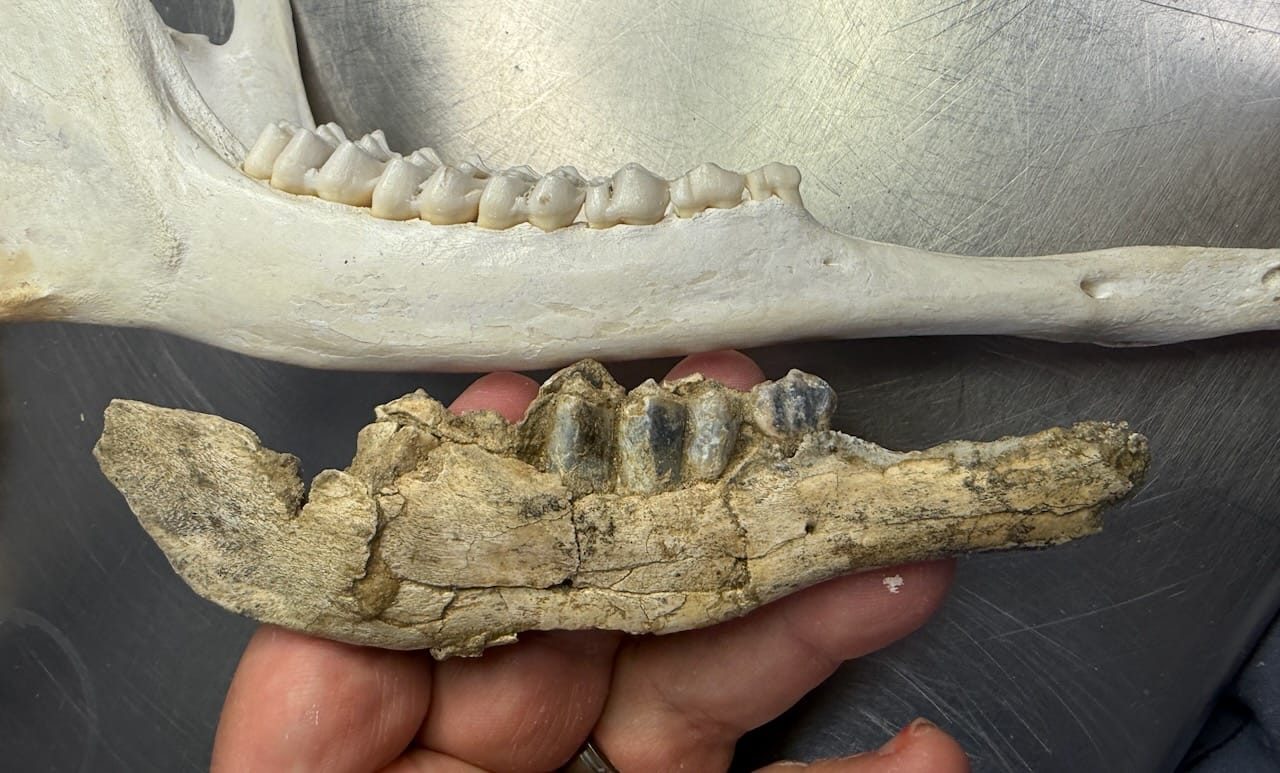
What all this added up to is that my initial identification was incorrect; instead of looking at an adult deer, I was looking at a very young animal that still had its deciduous teeth! Comparing the fragments to an adult white-tailed deer confirmed this:
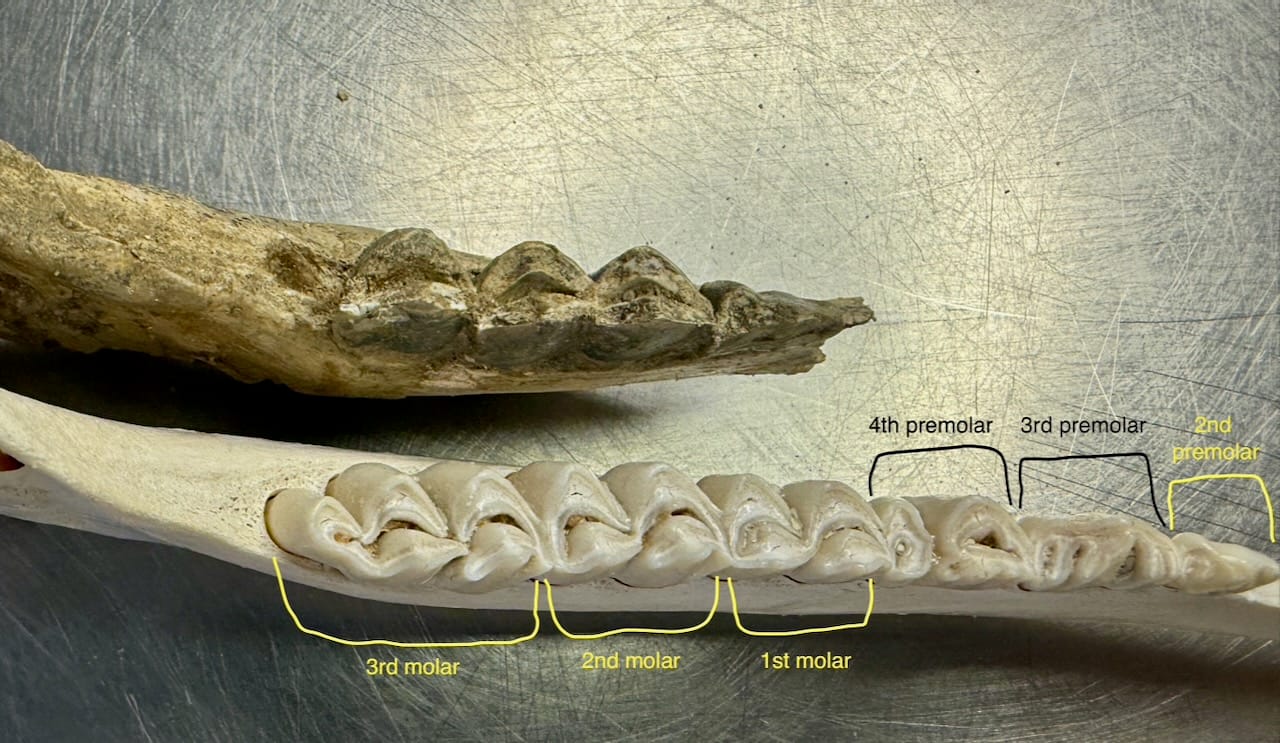
The adult deer teeth are labeled, and the unusual shape of last tooth is obvious. In mammal tooth replacement, there are no deciduous molars, so our fossil cheek teeth are premolars. In ruminants and their relatives, the 4th deciduous premolar usually has three columns of enamel, so we're looking at the deciduous 3rd and 4th premolars (dp3 and dp4).
In lateral views of each fragment, we can see that the jaw itself is only a little smaller than the adult deer, but the juvenile teeth are much larger. This suggests that we're looking at an animal that, as an adult, is much larger than a deer.
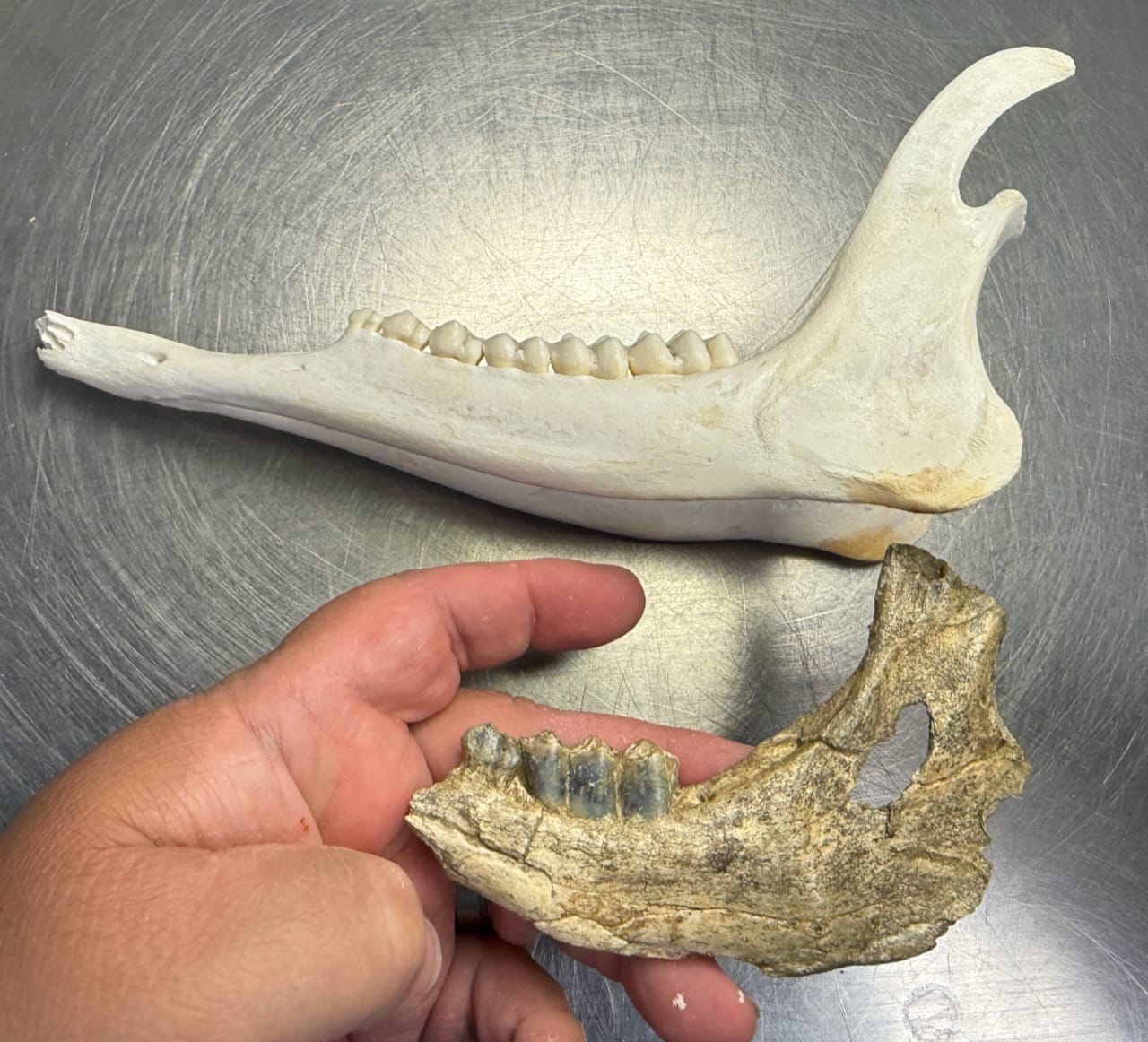
Also notice below how the deer jaw projects posteriorly at the bottom right corner. This is the angular process, which serves as the attachment point for the muscles that open the lower jaw. In our fossil specimen there's no projection in this area, more confirmation that this isn't a deer.
As it happens, a few years ago a local farm donated an infant dromedary camel carcass (Camelus dromedarius) to the museum. At our 2025 PaleoCon workshop, our visiting paleontologists dissected most of this specimen (known affectionately among the staff as "Dead Baby Camel"). We fed the remains to our dermestid beetle colony to extract the skeleton, so we now have a very young artiodactyl for comparison:
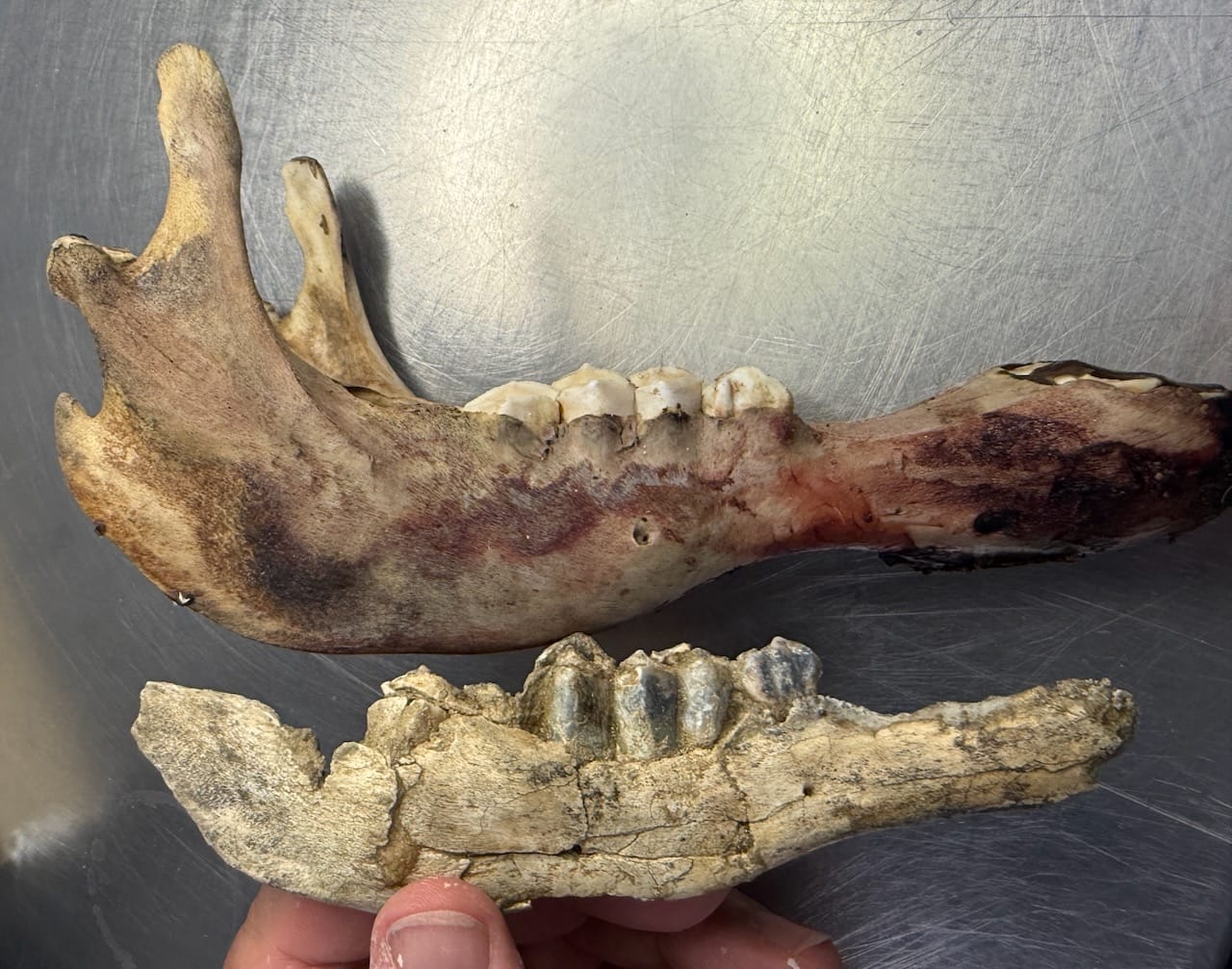
This is a very good size and shape match for our fossil. Note how the camel angular process (on the left in this view) forms a hook that sits fairly high on the back of the jaw, a different arrangement than in deer and consistent with our fossil specimen.
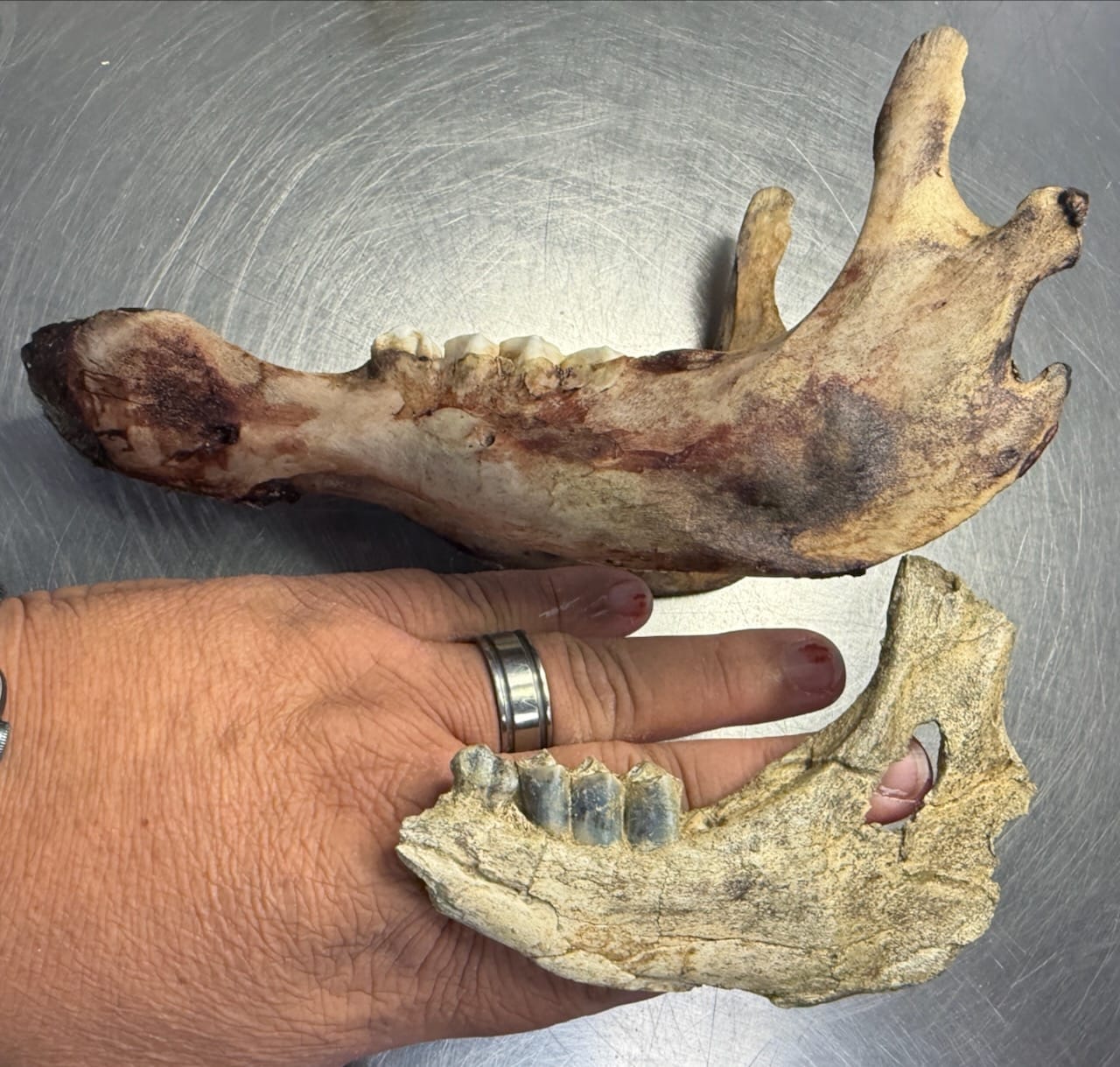
There are also only two check teeth, dp3 and dp4, again consistent with the fossil. It turns out camelids generally only have 2 deciduous premolars, while bovids generally have 3. The long, triangular 3rd premolar in occlusal view is also typical of camelids.
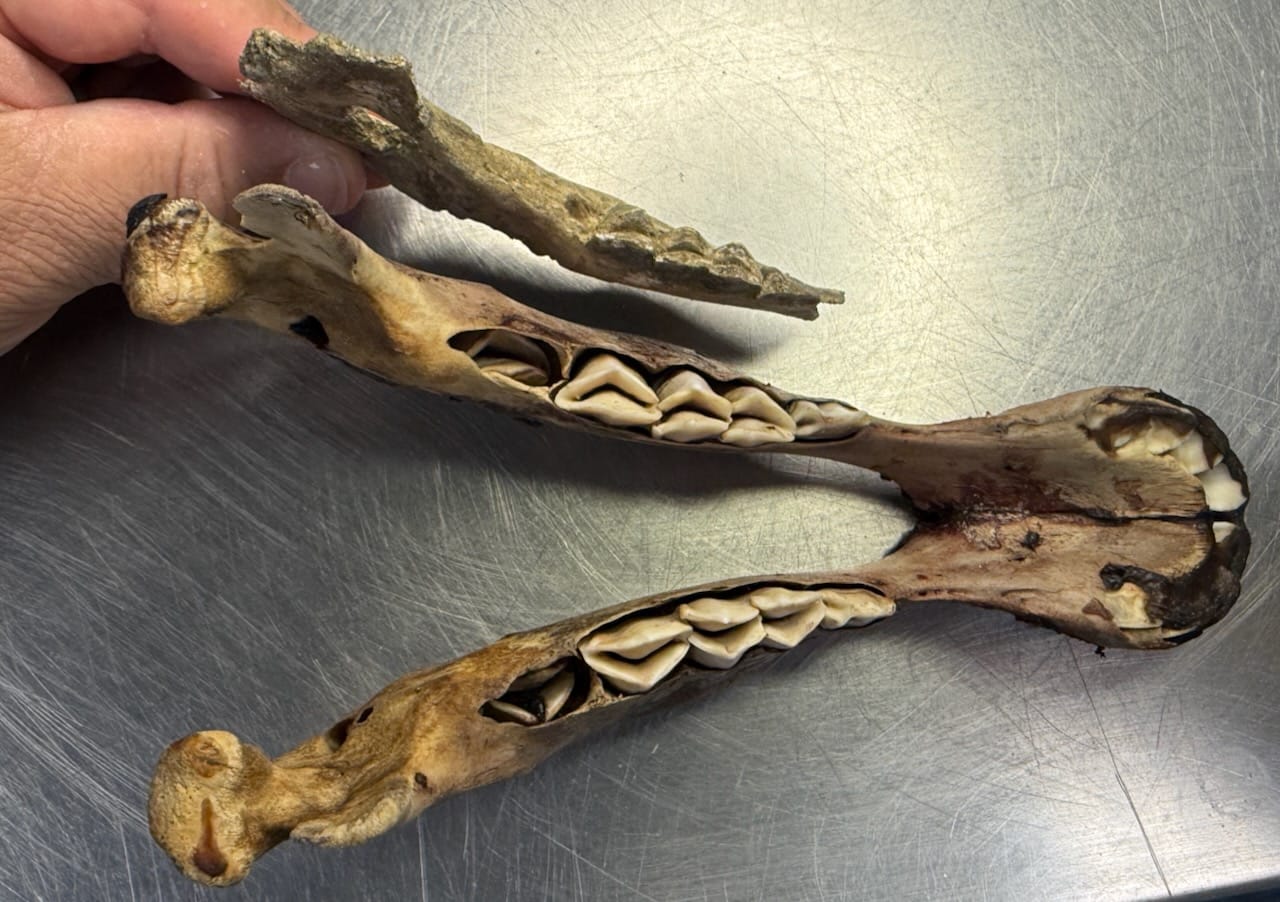
There are some differences between these specimens. The modern camel has a much thicker, more robust lower jaw, visible above. At first, I thought this might be pathological, since Dead Baby Camel died from a thyroid condition. But the fossil teeth are also quite a bit smaller. Moreover, Dead Baby Camel died when she was only a couple of days old, so the teeth show no wear at all, but the fossil teeth do show some wear, indicating that this animal was likely at least a few weeks old. That make me suspect that our fossil camel is more likely the llama Hemiauchenia (or maybe Palaeolama), rather than the much larger and more common Camelops.
So once again a specimen surprised us, once we had the time to examine it closely. The Murrieta camel is by far the youngest fossil camel we have in the WSC collection and gives us a great data point to help us better understand Southern California camelids. It's also going to get a prominent place in our new exhibit.
Here are some other posts featuring fossils we're considering for the new exhibit:
Mysterious Temecula Bones, Part 2
More Mysterious Bones for the New Exhibit
A Fragment of a Proboscidean – But Which One?
A Little Leg Bone from the Ice Age

If you like what you're reading, please consider becoming a paid subscriber or leaving a tip. All proceeds go to cover the cost of maintaining the site and supporting research and education at the Western Science Center.