More mysterious bones for the new exhibit
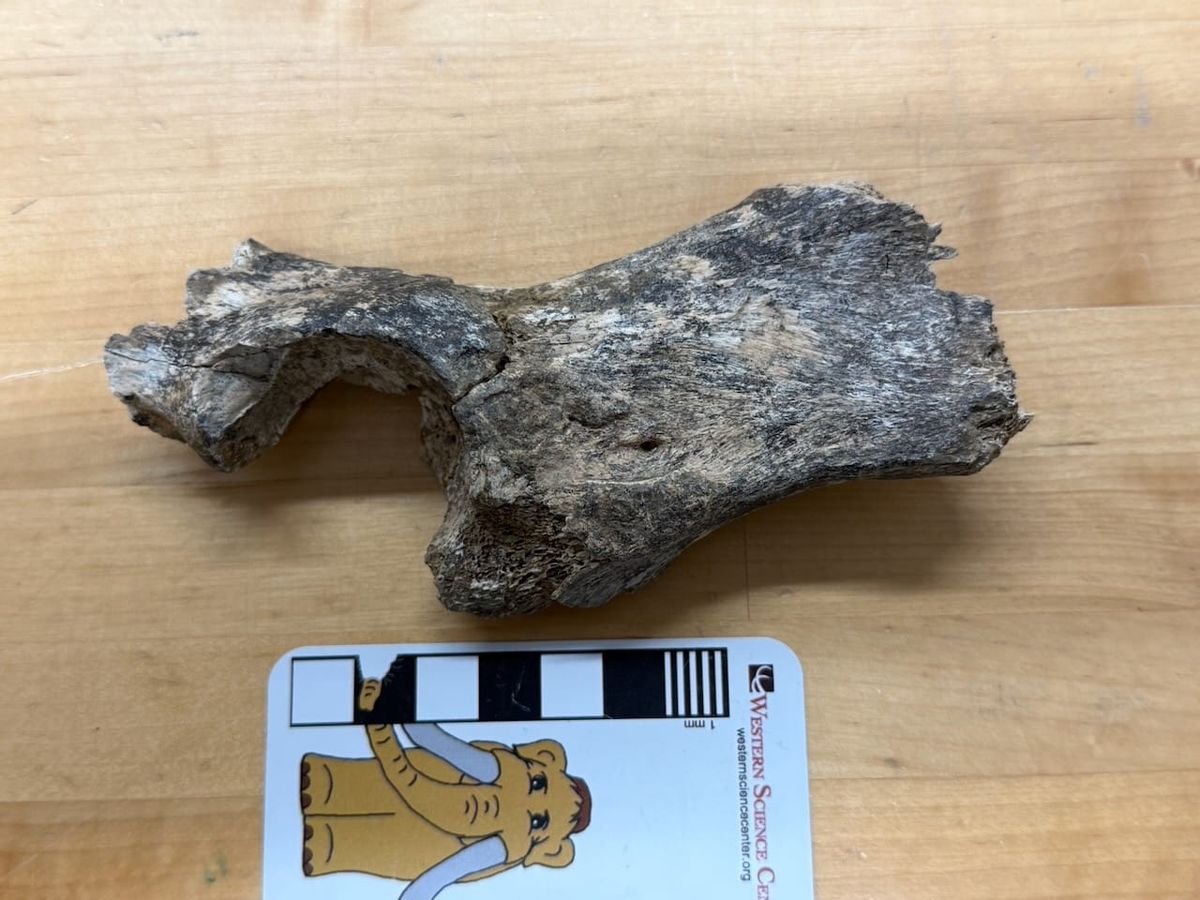
Over the last year we've been working on our new permanent exhibit about Ice Age fossils from Riverside County, which we hope to open this year. We have finalized the localities that will be featured in the exhibit, and now we're in the final stages of selecting the individual specimens for inclusion. Since we're trying to show off the diversity of the Ice Age mammals, identifying small bones and bone fragments is an important part of the selection process – an otherwise unimpressive bone might be included if it's the only evidence that a species lived in a particular place.
That brings us to Woodside, a poorly-documented site in the northeastern part of Temecula that produced a few dozen bones. Like most of our fossils collected from Temecula Valley between 1990 and 2010, the mitigation company did not record basic information like site maps, stratigraphic data, or even specimen counts, so we're gradually sorting through the collection trying to salvage as much usable scientific data as we can.
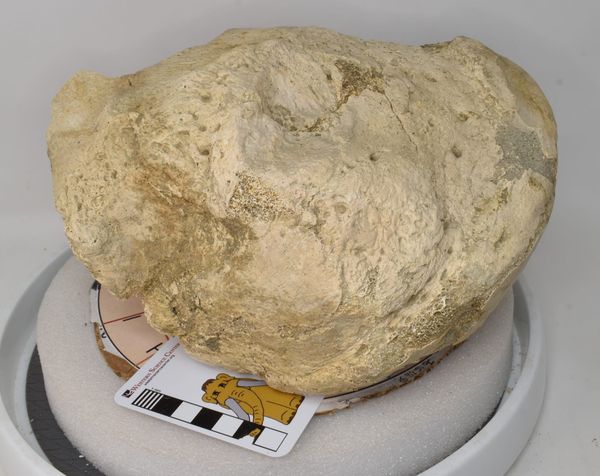
Like most Inland Empire Ice Age sites, Woodside is dominated by the horse Equus occidentalis, and at first I thought this was the only species present there. But a couple of weeks ago we found several other bones from the site. Two of them appear to be from the small deer Odocoileus, but the other two I couldn't immediately identify, a pelvis fragment and a toe bone. Today I want to focus on the pelvis, shown at the top of the page.
I quickly identified the fragment as a small part of the right innominate, part of the pelvis. The round cavity in the middle is the acetabulum (hip socket). The innominate is formed by three bones fused together, and parts of two of them are preserved. The blade of bone extending to the right (anterior) of the acetabulum is the broken ilium, while the small broken surface on the left of the acetabulum is the broken base of the ischium; the third bone, the pubis, is not preserved.
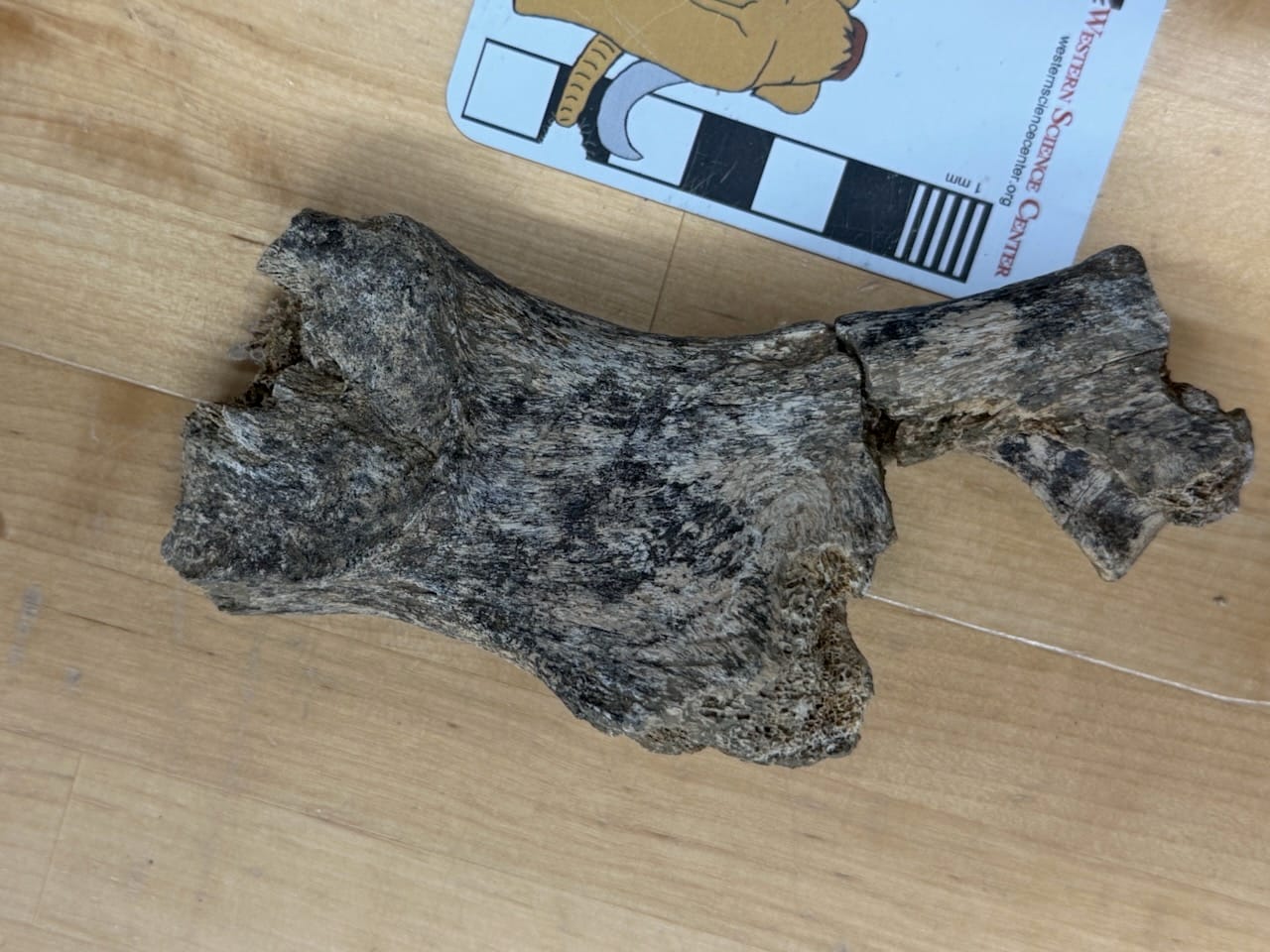
Turning the bone over we can see the medial surface. The round flat area on the left (anterior) is part of the ilium's articulation with the sacral vertebrae, where the hips are attached to the backbone.
With my usual process of elimination, I could rule out proboscideans and sloths (sloths have enormous hips), as well as the common small animals such as white-tailed deer. Bison and Camelops seemed too big, although I couldn't completely rule out a young animal in this case, but the shape didn't match very well. The best size match was a horse, which happens to be to most common large mammal in the valley; in fact, one of the other Woodside fragments is from a horse pelvis. But the morphology is not a very good match. So what are some other candidates that are in about the same size range?
At the same time I was working on this specimen I was also working on identifying the toe bone from the same site, and based on size I thought it was possible the pelvis and the toe could be from the same animal. Two candidate species that had come up in my work on the toe was the large deer Navahoceros fricki and the tapir Tapirus californicus. Both were in the right size range, but Navahoceros has never been reported in this part of California, and comparison to an elk pelvis in our collection wasn't promising. Tapirus, on the other hand, has long been known from the valley; at WSC we have tapir fragments from another site in Temecula. Unfortunately we don't have a tapir skeleton in our collection, but I was able to download a modern Tapirus indicus pelvis from MorphoSource, which had been uploaded by the Burke Museum of Natural History. I had also made a digital model of our specimen, so I put the models together in the same file so I could compare them directly.
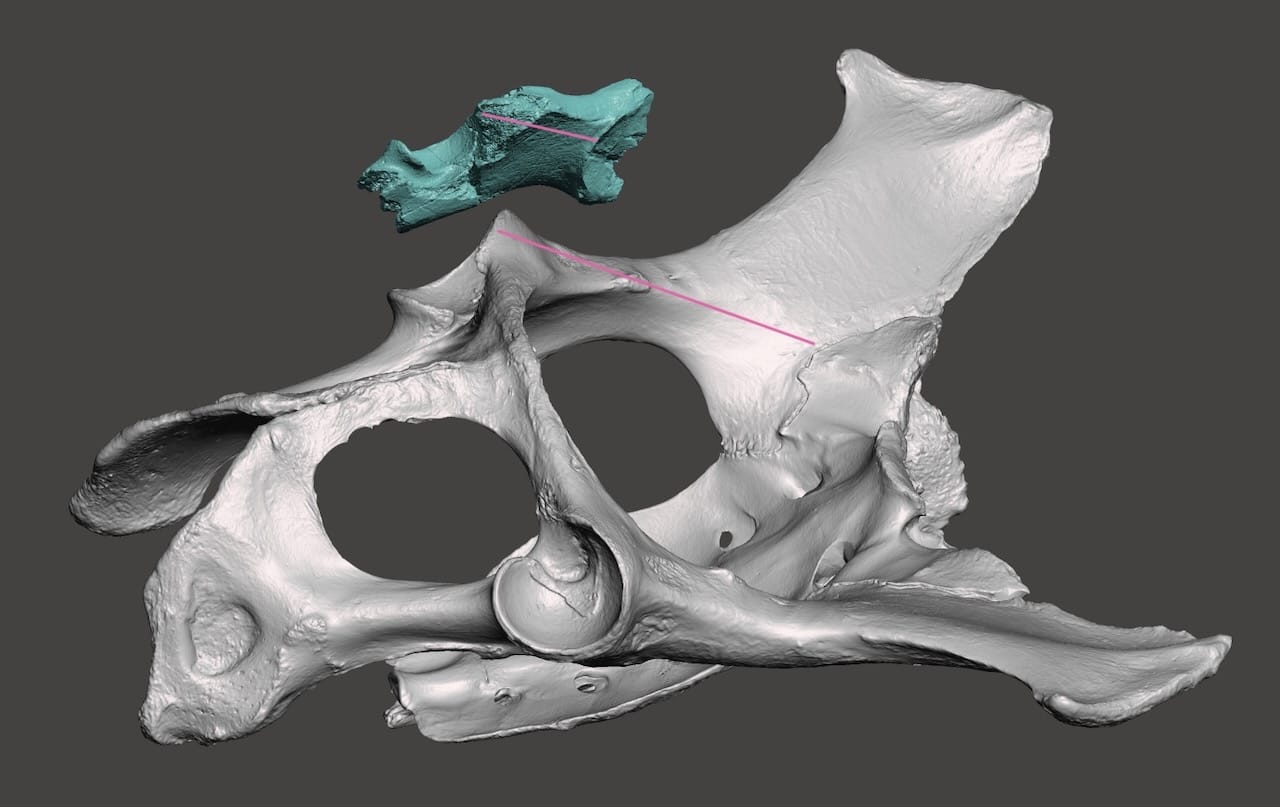
This is an unusual view, ventro-oblique, but it allows us to simultaneously see the right hip socket and the attachment of the right ilium to the sacral vertebrae. The pink lines show the distance from the front of the hip socket to the sacral attachment, which is much longer in the tapir than in the Woodside specimen. I had high hopes for a tapir, but this definitely is not one.
At this point it was clear that this fragment was something rare. I had been through all my likely candidates without a match, and even long shots like Tapirus didn't work. But there are other groups that are vaguely in this size range but are much less common; carnivorans. While carnivores get lots of attention, they are usually very rare as fossils. The Tar Pits at Rancho La Brea are a predator trap that preferentially preserved carnivores, but in most places they only make up around 1% of the specimens. If you have a site with only 50 or so bones it very unlikely that any of them will be carnivores.
It happens that we do have an American lion (Panthera atrox) innominate from Diamond Valley Lake in the collection. When I compared digital models of the specimens it was actually not too bad, except that the lion was quite a bit bigger. But of course, sabertooth cats are known from Southern California, and are a little smaller than American lions. We happen to have a cast of a Smilodon fatalis pelvis at the museum.
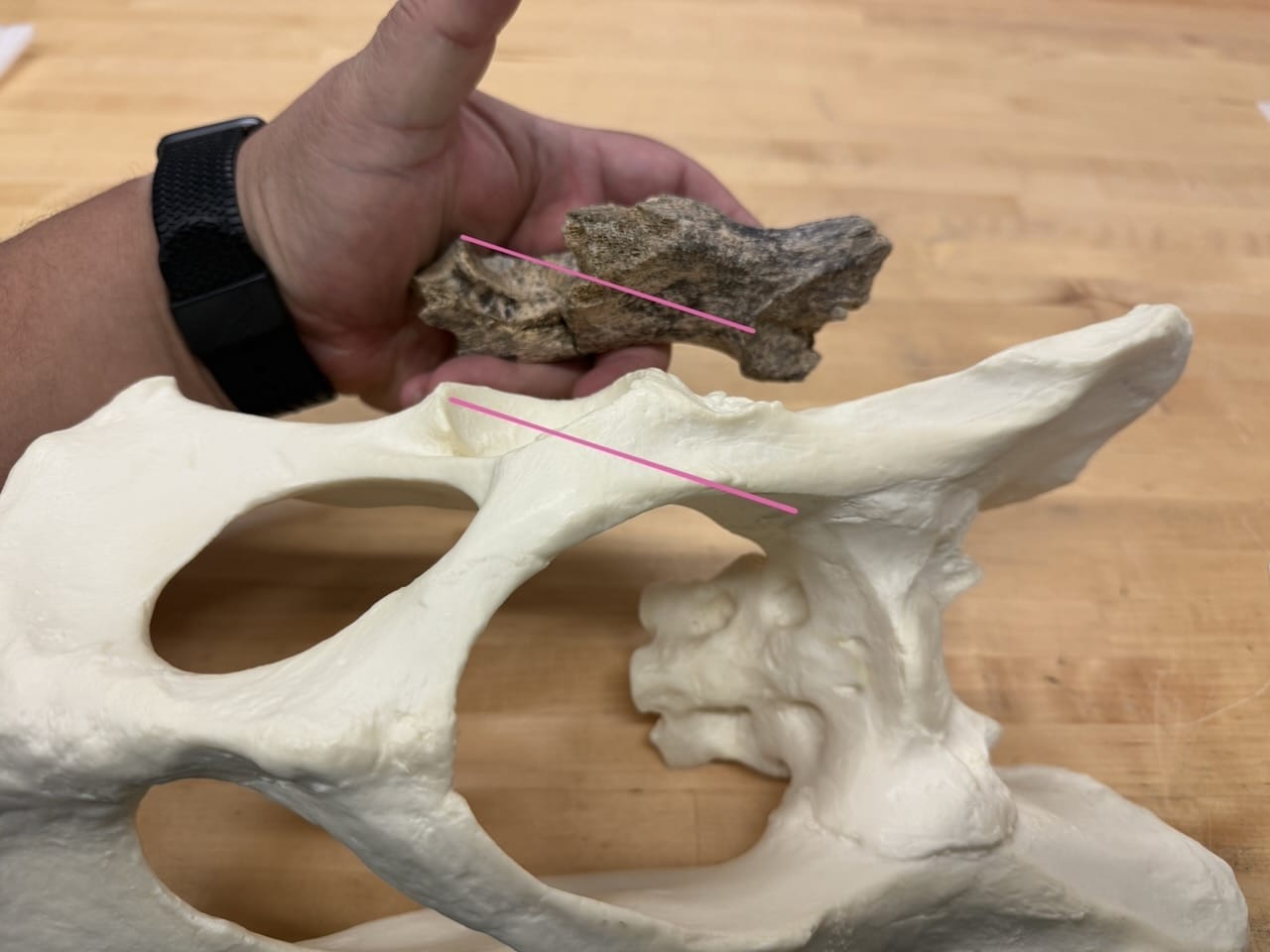
This view is close to ventral. The pink lines in this case run from the back of the acetabulum to the edge of the sacral articulation, and this time they're almost the same length in the two specimens. The overall shape and proportion are also a good fit.
Woodside is such a small collection that I didn't really expect to have any carnivore bones. But sometimes you beat the odds, and it turns out we now have a record of Smilodon in a new location. In my next post we'll look at the Woodside toe bone, and see if it really does come from the same animal.
Here are some other posts featuring fossils we're considering for the new exhibit:
A Fragment of a Proboscidean – But Which One?
A Little Leg Bone from the Ice Age

If you like what you're reading, please consider becoming a paid subscriber or leaving a tip. All proceeds go to cover the cost of maintaining the site and supporting research and education at the Western Science Center.