Making sense of a vertebra
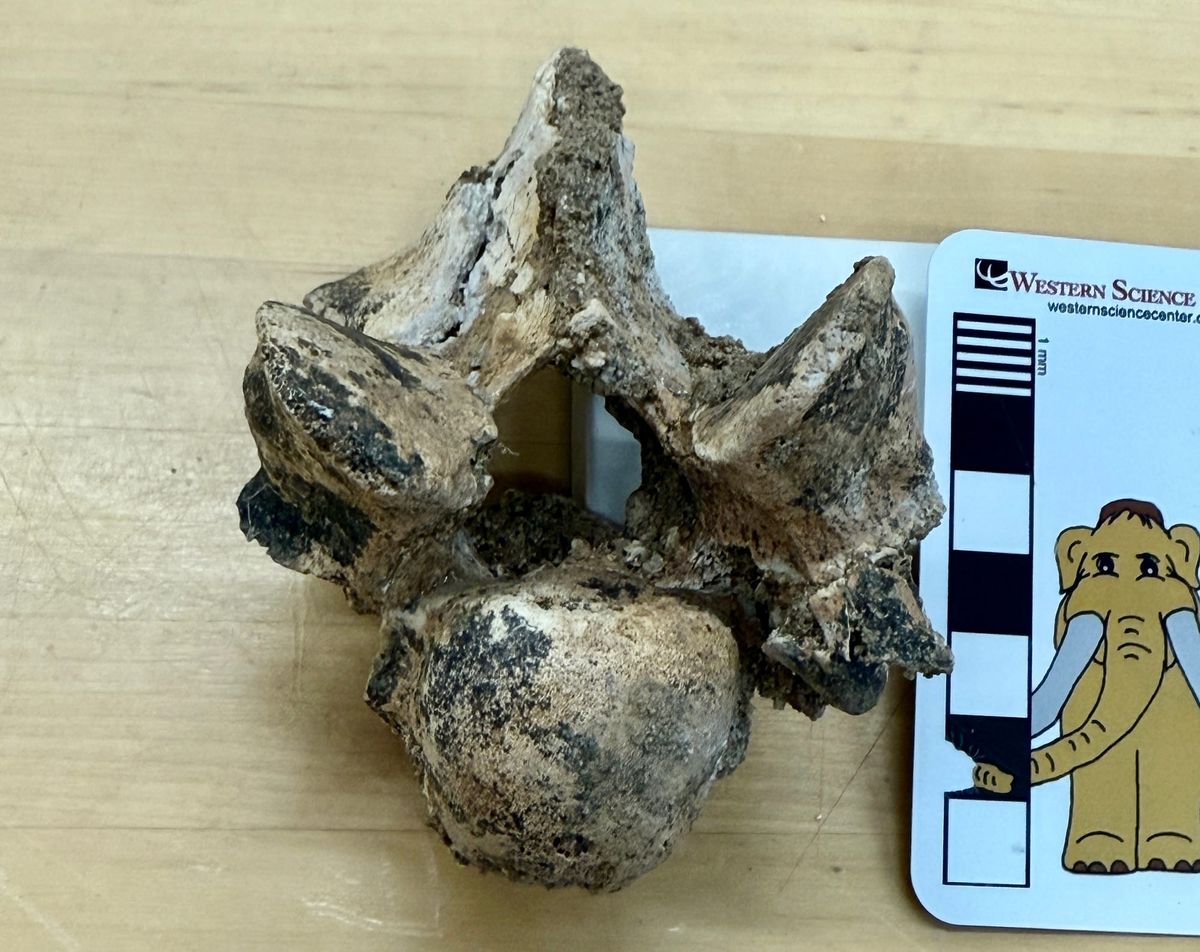
As we prepare our new exhibit, we’re drawing on collections from Riverside County that have mostly been recovered by mitigation companies. These companies generally do a great job of documenting and identifying specimens, but there are outliers. Unfortunately we have acquired a number of specimens that weren’t prepared or identified, or that include even basic locality information. Without this data a fossil is almost completely useless scientifically, so our staff has spent a lot of time and effort trying to track down where these specimens came from and then work out what they are.
We’re pretty sure the vertebra shown here came from a housing development near the French Valley Airport, near the cities of Temecula and Murrieta. That makes it a candidate for our new exhibit, if we can figure out what it is! This fossil is clearly a vertebra, but what position and from what kind of animal? The identification will be trickier because the specimen is somewhat crushed and significant portions are missing.
At the top is the anterior view. Two things are immediately obvious. First is that there are creases on each side of the neural spine at the top of the vertebra, indicating that there has been some crushing from side-to-side (which also accounts for the asymmetry in this view). The second is the large hemispherical surface on the anterior face of the centrum. This ball would have articulated with a deep socket in the preceding vertebra (a “ball-in-socket” joint). This is condition is referred to a opisthocoelous, and it’s fortunately rare in mammals, only being found in the anterior vertebrae of a few groups. Unfortunately, these groups include bison, camels, and horses, the three most common Pleistocene animals in this size range from our area! Of those three possibilities, a horse is easily the best match in terms of size to our specimen, since bison and camels are considerably larger, and the fusion of the ball joint onto the vertebra indicates that this vertebra was finished growing.
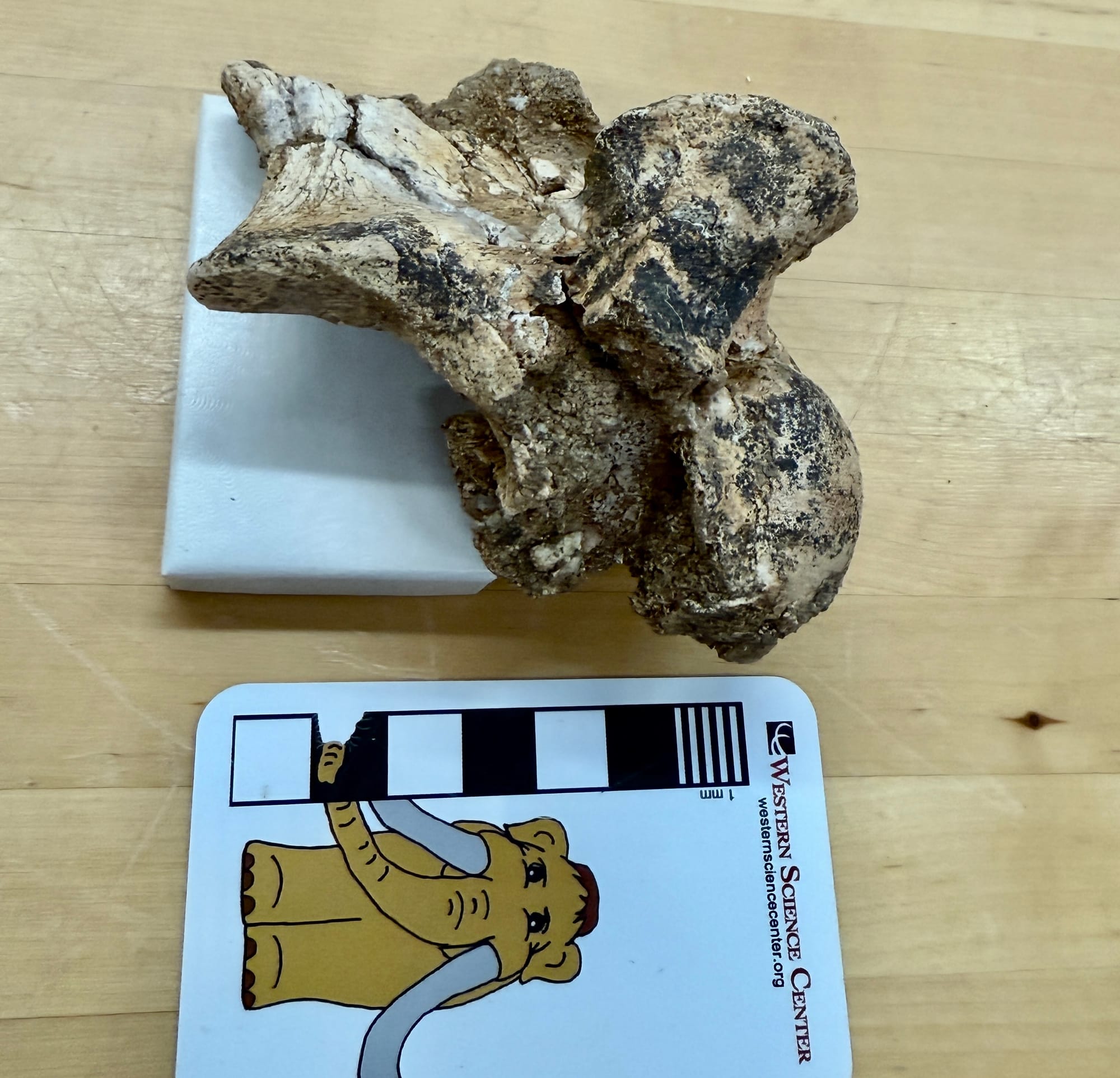
We can see some additional feature in lateral view:
Here’s a labeled version of the same image:
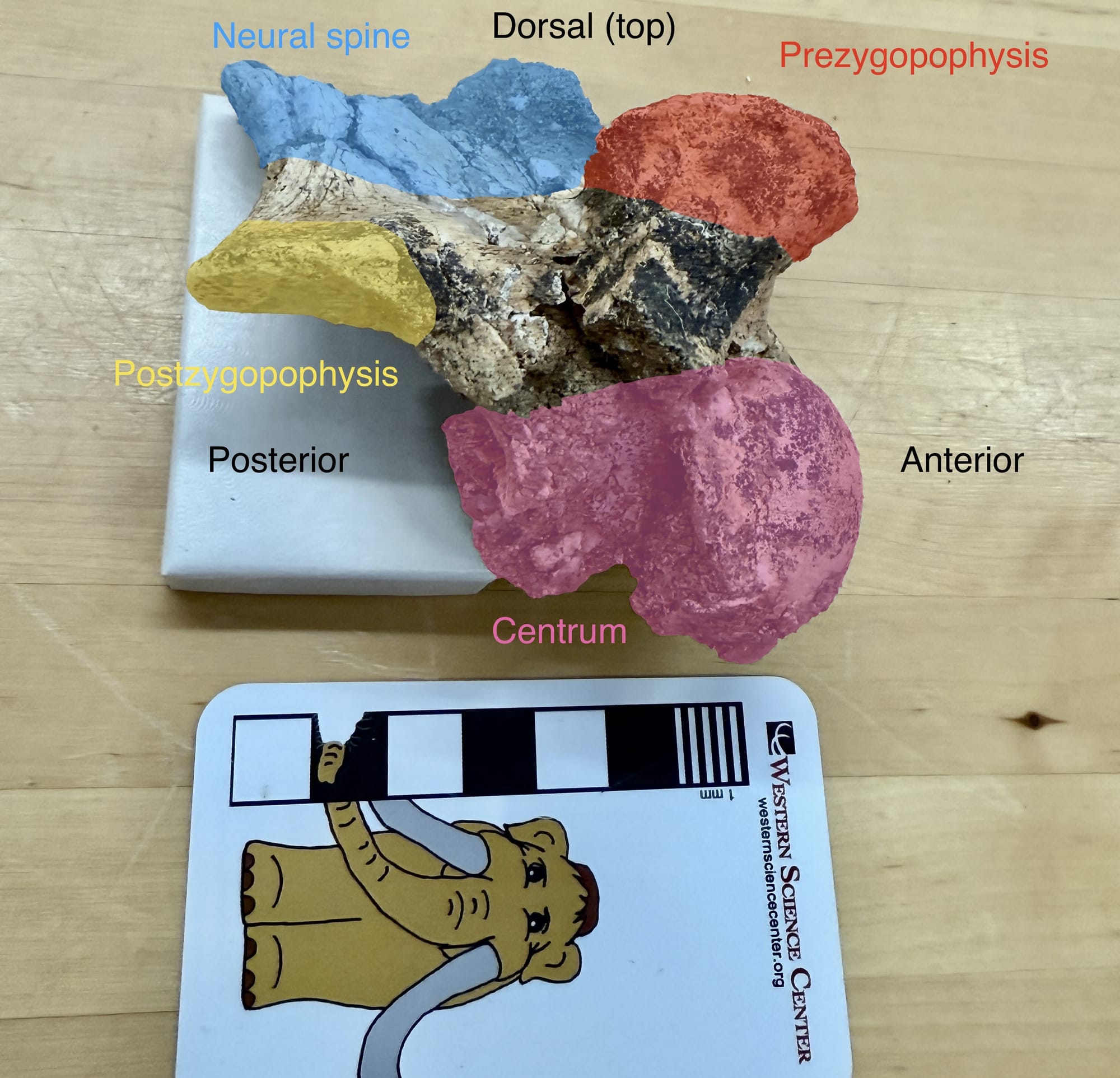
So, a few observations in this view. We can generally tell cervical and thoracic vertebrae apart by the presence of rib articulations in the latter, but unfortunately those areas are damaged in this specimen. However, the zygopophyses are pretty large; this suggests that the vertebra is located near the front of the animal, either a cervical or anterior thoracic vertebra. But the centrum is fairly short. Horses have long, robust neck vertebrae. So this is likely from the very end of the neck or one of the first few thoracics. We have a partial modern horse skeleton in our osteology collection, so we can compare them directly.
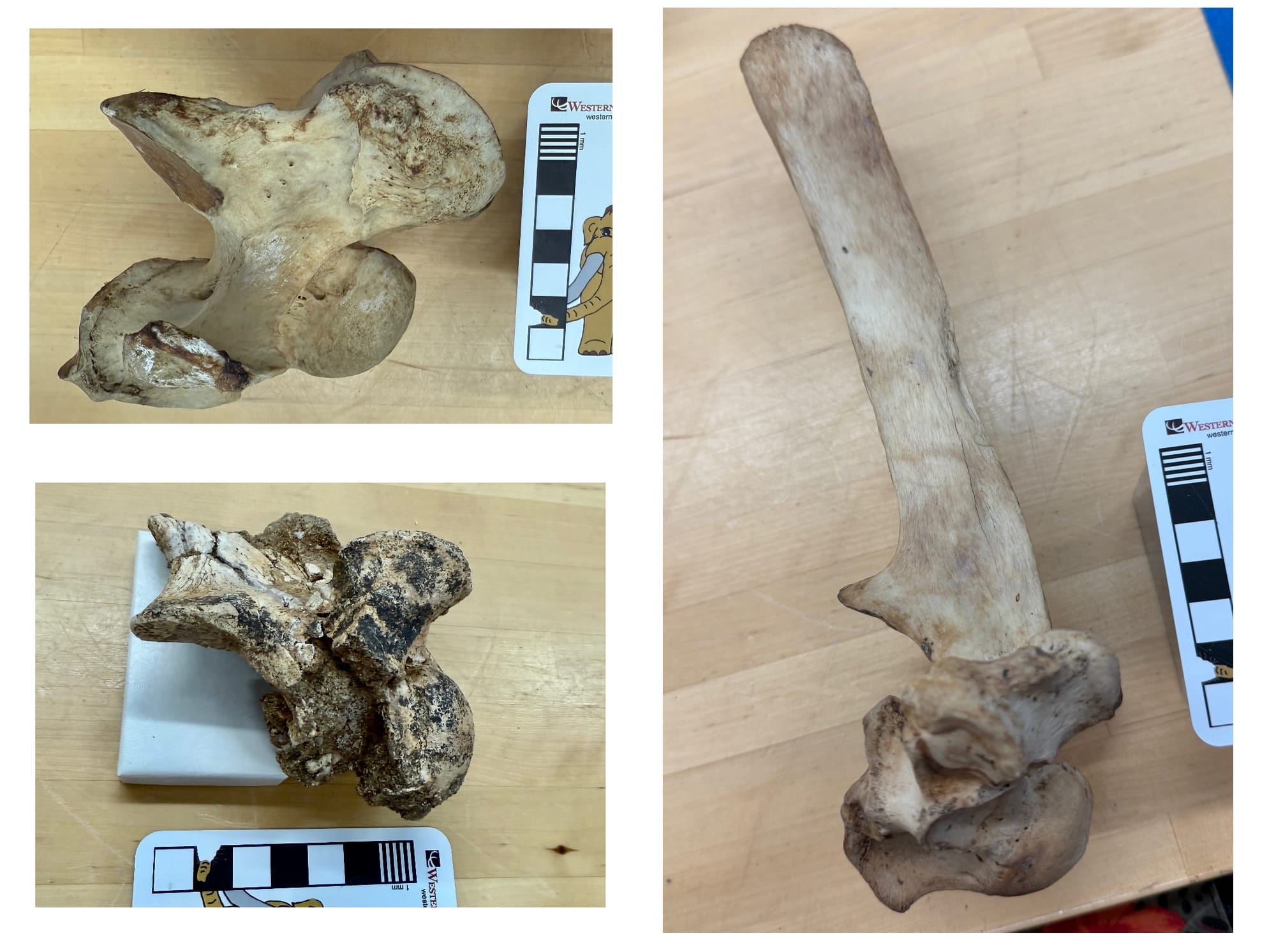
All of these are shown in right lateral view. The fossil vertebra is on the lower left, while the modern 7th cervical is on the upper left and the modern 2nd thoracic is on the right (unfortunately our modern skeleton is missing the 1st thoracic vertebra).
The 7th cervical has a much longer centrum and much larger zygopophyses than our fossil, and a short, anteriorly-angled neural spine (just visible behind the prezygopophysis). All of these features differ from our fossil specimen.
The 2nd thoracic is a much better match, but not perfect. Like our fossil specimen, the neural spine angles posteriorly (don’t let its great height fool you; the neural spine is broken off in the fossil). The centrum and prezygopophyses are a little smaller in the modern specimen, the postzygopophyses are much smaller, and the neural spine angles less sharply posteriorly (notice the sharper angle between the back edge of the neural spine and the postzygopophysis in the fossil).
We don’t have a specimen to make a direct comparison, but based on these observations I think our fossil specimen is the 1st thoracic vertebra. There is one more test we can do, though. By lucky coincidence, our modern horse skeleton is almost exactly the same size as most of our fossil Equus occidentalis specimens, to the point that we can articulate the fossil and modern bones with each other. That means our fossil should articulate with the modern 2nd thoracic vertebra, and it does so very nicely:
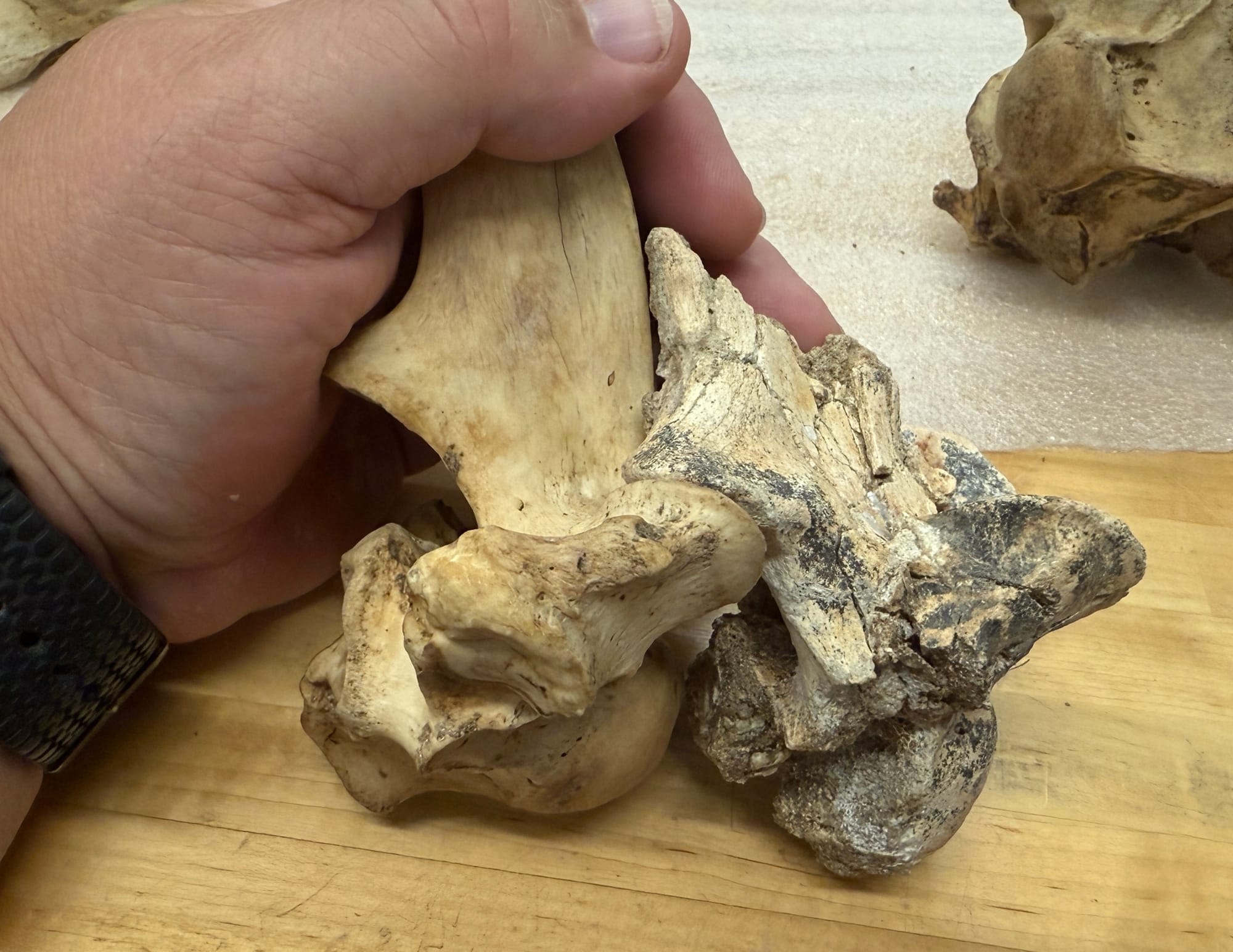
With an identification and a pretty good idea of where this specimen was collected, it actually has some scientific value and is a candidate for inclusion in our upcoming exhibit.
Here are some other posts featuring fossils we're considering for the new exhibit:

If you like what you're reading, please consider becoming a paid subscriber or leaving a tip. All proceeds go to cover the cost of maintaining the site and supporting research and education at the Western Science Center.